March Notebook
For months I’ve been vaguely mulling over non-monogamy as social phenomenon, ever since I came across some essentialist claims about men in Daniel Mendelsohn’s The Elusive Embrace. “All of the successful, happy gay couples I know, the ones who show an enviable depth of emotional commitment, have one thing in common,” he writes, “and that is that they look for, and find, sex outside their loving relationship.” He goes on to say that this “suggests what is obvious about gay men—and therefore, of men in general, since gay culture is nothing if not a laboratory in which to see what masculinity does without the restraints imposed by women: that sex for men is, finally, separable from affect.” Am I correct in understanding this to mean that women force monogamy on men, that monogamy exists only because of female power and will? I personally have, since early adulthood, believed the opposite: men impose monogamy on women. That conclusion was based not only on my own inclinations or the fact of severe social stigma, but on well-documented and still extant material punishments for women’s unsanctioned sexual activity, such as impoverishment, institutional confinement, separation from their children, and the death penalty.
That isn’t really the point, though. I was more bothered by his confidence that there are no gay men who would want monogamy, let alone ask for it, or perhaps the implication that if a gay man did ask his partner for it, he’d doom the relationship by doing so. I dwelt on this because two gay couples in my life are getting divorced, and one was polyamorous through sincere, mutual desire, while the other was non-monogamous in a limited manner due to the wishes of one party and reluctant consent of the other. I thought, too, of another gay couple—yes, I know three! at least!—and my private suspicion that one operates under a don’t ask, don’t tell policy while the other thinks his marriage is monogamous. But this is just my hunch. Where do these couples fit into Mendelsohn’s relational cosmology? And were additional sexual partners really the only thing every successful, happy couple he knew had in common? Not financial security, or health, a certain shared upbringing, the absence of children, etc?

Cecily Brown’s Kiss Me Stupid
To suggest that non-monogamy can function as prophylactic and cure for the worst relational ills is, to my mind, the domain of deeply immature/inexperienced people, whatever their age. I’m not saying DM believes this, only that many people behave and speak as if they do, whether or not they’ve articulated this conviction to themselves. Similarly, I think it’s a common, tacit assumption among city dwellers, straight and gay, that queer romantic relationships are on the whole happier and more durable than straight ones, and this assumption is often predicated, unconsciously or otherwise, on the presence or presumption of non-monogamy in queer partnerships.
Determining which category of people is best at love is not an interesting or worthwhile project to my mind. But contemplating this tendency to declare a sort of romantic winner or universally successful romantic formula is. The mistakes people make in love, how they intentionally and accidentally damage their relationships and then try or refuse to learn from what they’ve done or failed to do (and I include myself among mistake-makers) is an evergreen fascination for me. A lot of my writing, whether or not I successfully conveyed this in the work itself, was spurred by the pain of knowing—intellectually but also intimately, through experience—that patriarchy can preclude or ruin love, and regularly does. I like to think about how this can be overcome and repaired on an interpersonal level because I don’t want to wait until patriarchy is vanquished to experience love with a man. I simply don’t have that long!
I apologize for stating the obvious, I know it’s obnoxious and maybe I’m putting this in a reductive way. But gay men are not outside of patriarchy. (lol) And being non-monogamous doesn’t spirit you and your stable of lovers away to No Patriarchy Island. I think polyamory discourse is so cluttered and messy that it might be refreshing to lay down these basic points. Fucking a lot of people doesn’t make you good at love, just like fucking only one at a time doesn’t. But I guess these conversations frequently aren’t actually about love, and it’s my error to respond as if they are. They’re about (what’s described as, propagandistically,) a timeless misalignment of the sexes, about women’s unreasonableness, our erotic satisfaction and lack thereof, the presumed insatiable sexual appetite of every man, social breakdown, marriage as institution, and so on.
The recent Lindy West discourse, of which I have entertained both too much and yet a mere sliver, seems driven by the fears of women who sleep with men. These women might be afraid that a man will one day ask them to be polyamorous or open, especially as an ultimatum or “request” made amid affairs already underway, but I think there’s a crueler mental jockey wielding the whip. Women fear being publicly humiliated by their male partners, whatever form that humiliation takes. They fear debasing themselves for men who do not love or respect them. And they fear this will happen while they cling to the debasing, humiliating arrangement with transparent delusion and desperation—i.e. that they will participate, eagerly, in their own degradation, as family members, friends, and strangers look on. I don’t think any of this derives from an inborn shrewish allegiance to monogamy/sexual frigidity. Fucking other people while in a supportive and stable dyad might appeal very much, in theory, to male-partnered women, but the wealthy white women writers who sleep with men have on the whole failed completely at making non-monogamy seem equitable, dignified, or loving. They might expend thousands of words claiming it’s all of those things, but their claims are not persuasive.
I am depressed by this. My diagnosis is that we (onlookers? participants in this pathetic culture?) are suffering from an inability to talk about what we actually want to talk about: connection, respect of the other, respect of the self, the possibility of living with decency and intelligence. I believe we hunger for this badly, especially since every day seems to push us collectively further from a life of meaning. This is an ongoing preoccupation of mine that I intend to expand on in the near future.
Here’s another aspect of the Lindy West circus that troubles me. The era of the personal essay is famously dead yet it feels that mainstream American culture is increasingly fueled by (mainly white) women, not really as artists or professionals but as personalities, psychological studies, consumers, spectacles, raw material. Charli XCX and Taylor Swift, Mormon reality stars, Heated Rivalry’s rabid fandom, romantasy readers, Elizabeth Gilbert’s latest fiasco, Miranda July’s whole deal, West End Girl, Emerald Fennel, TikToks documenting how a random woman’s husband openly hates her and the subsequent front-facing responses in which the random woman explains that her husband’s hatred of her is a hilarious shared inside joke, perhaps even the basis of their entire relationship. Sex hovers around most of these flashpoints but it’s never addressed in a direct and honest way. It’s just sort of like, ew, horny women, or wow, horny women! The cowardly, visionless, algorithm-chasing manner in which most media outlets conduct themselves now is of course largely to blame.
I suppose my working theory is that ten years ago, when young women barfed up articles detailing how they forgot to take a tampon out for eight days or whatever, their stories entered a conversational stream about weird tweets and celebrity gossip and prestige TV. It’s not that the public churn of that time was of higher quality, but that it was at least somewhat more heterogenous. Now, it’s just openly vile white men (Joe Rogan, Clavicular, what have you) and (sightly, possibly) less reprehensible white women. That’s it. If you want entertainment, you can have Nick Fuentes or Call Her Daddy. I’m overstating it, a little, but perhaps managing to outline the general situation?
I’d like to share a recent passage by Clare Francis that I found clarifying.
Cultural criticism is now solely women yelling at each other—myself included, obviously—about insular controversies no one else in the world cares about, and contemporary literature on women weakly grappling with sexual taboos. Men aren’t even invited to the party, except to selectively yell at Girl Enemy of the Week. Women thereby also become the vessels for all intellectual discontent, while the few men that are around just continue their angry crusades against everyone who they feel has wronged or ignored them, under the guise of being critically rigorous.
This is long, and not a proper essay but essentially a collection of semi-shaped thoughts. I feel ambivalent about posting it because I’m worried I haven’t said anything of value. So I’d like to end with an offering about which I feel a little more confident.
Last week, I started reading Thich Nhat Hanh’s Cultivating the Mind of Love. It shocked me immediately with a disclosure that I’d never seen hinted at anywhere else. (I emailed William to ask if this information was as surprising to him as it was to me. He said yes!) It feels like a big secret, though it is not because it’s printed in a book. When he was 24 and already a monk, Thich Nhat Hanh fell in love, in romantic love. With a nun.
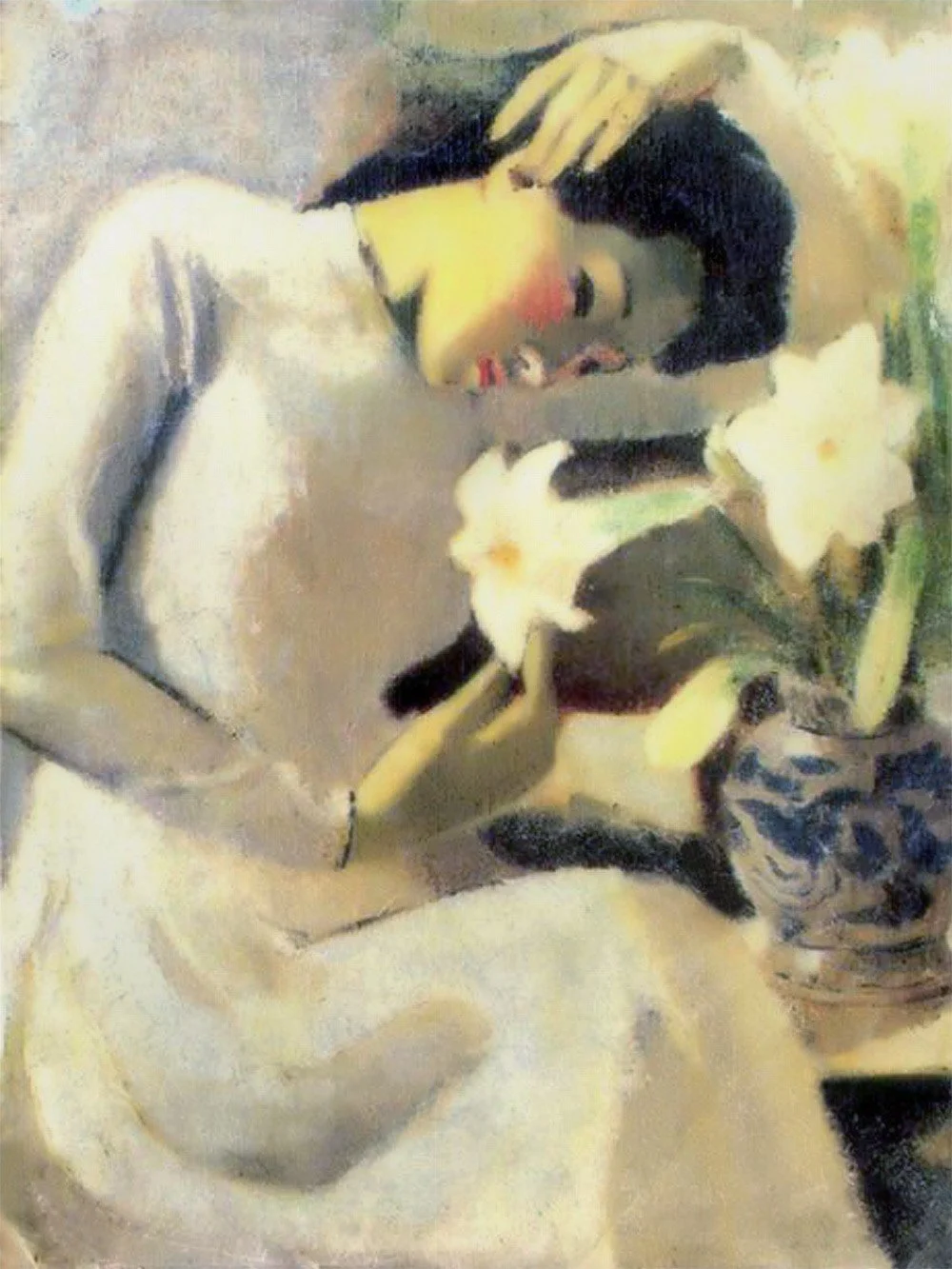
Here‘s a bit of how he relates this experience which, forgive me, I dilute with extraction:
As I was walking up the steps to return to the temple, I saw a nun standing there, looking out onto the nearby hills. Seeing her standing like that was like a fresh breeze blowing across my face. I had seen many nuns before, but I had never had a feeling like that.… When I met her, it was not exactly the first time we had met. Otherwise, how could it have happened so easily?… The moment I saw her, I recognized in her everything I cherished.
He speaks to her briefly, then excuses himself: “I didn’t know what had happened but I knew my peace had been disturbed. I tried writing a poem, but I couldn’t compose even one line!” He turns to the poetry of others, and recites it for hours, “all afternoon and evening…trying to relieve the feelings in me that I could not understand.”
The following night, after speaking with her again, he manages to write a poem of his own. This is one verse of it.
Very tenderly, the wound opens itself in the
depths of my heart.
Its color is the color of blood.
There are truthful, careful ways of writing about love, and there are dishonest, careless ways of writing about it. There are also truthful, careful ways of doing it, and then there are the more common careless, selfish ways. If someone writes about their love, the writing and the doing necessarily inform and inflect each other. I think this will be true regardless of whether other people read the writing or not.
My impression is that there isn’t a lot of valuable work about love being published right now. But please let me know—I really mean it!—if I’ve been reading the wrong things.